
It hasn’t yet felt very springlike in Paris but it seems France is not an exception. In Helsinki, the capital my home country, it snowed a few days ago, and no, snow doesn’t cover streets all year around over there! I bet many Europeans are at the moment eagerly waiting to see some more green color, flowers blossoming, birds singing… not forgetting the sun! If you have no time or money to buy a ticket to the Caribbean, I suggest you get a feeling of the approaching summer in the Conran Shop in the 7th arrondissement (http://www.conranshop.fr). They organized une soirée privée last Thursday that we could not attend (busy eating tajine instead…) so we took the opportunity to visit the shop last Sunday.
Some of my personal highlights are presented below.
I come from Finland so I adore this table, and even if I didn’t originate from Finland, I still would! Surely many of you recognize it, but if not, check it out on internet (google Tulip Table Saarinen). Eero Saarinen, the architect born in Finland, designed this table in the mid-fifties for Knoll and today, almost 60 years later, it is as modern as ever.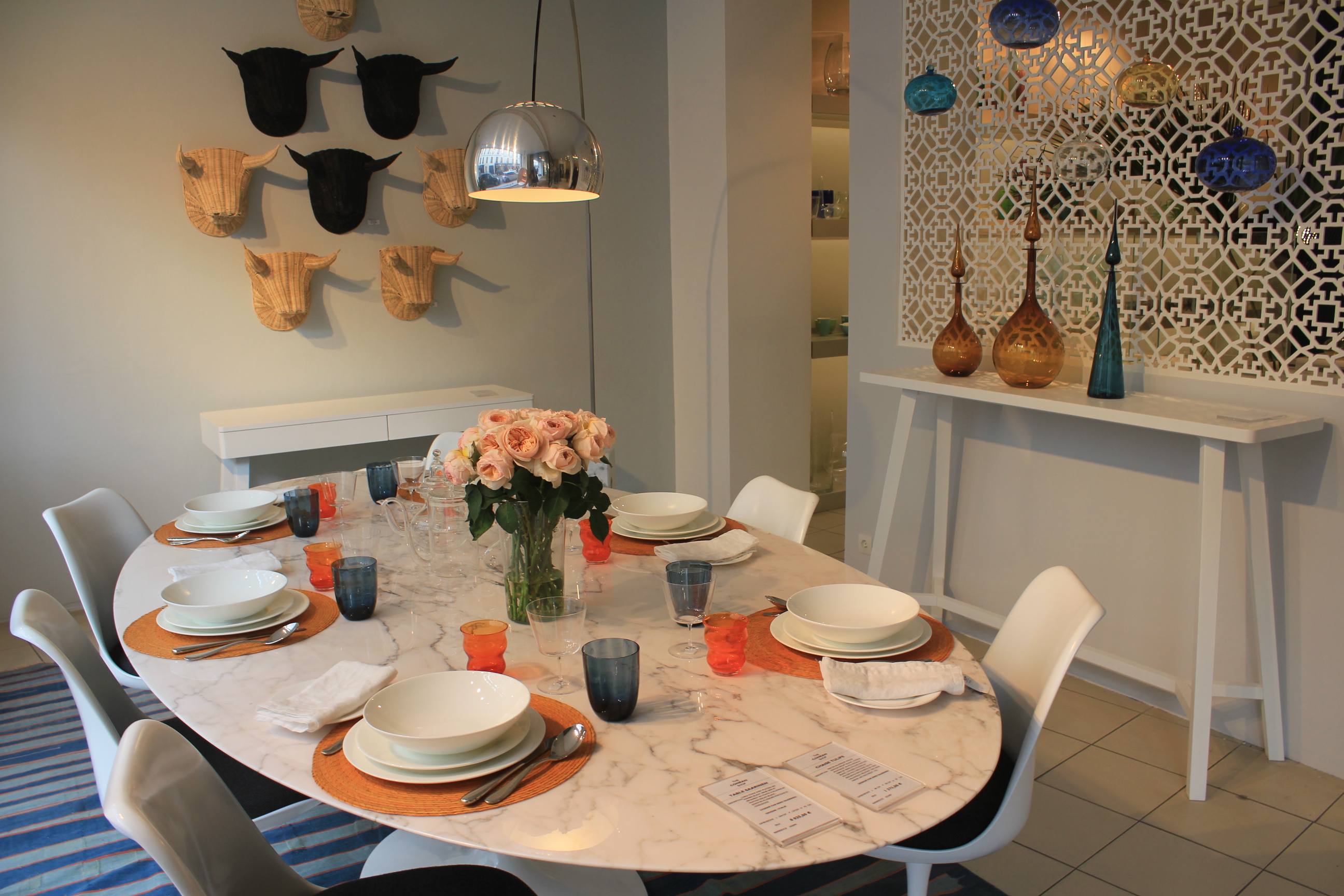 FYI: Those stylish bull heads on the wall are called Trophée Taureau and sell for 135€/head.
My next stop in the Conran Shop was related to animals too: I found canned fish in super-cute packaging:

 José Gourmet (http://www.josegourmet.com) is a Portuguese brand that produces jam, wine, olive oil, vinegar, canned goods, etc. with elegant and fun design. Their canned fish selection resembles more a Japanese restaurant than a traditional tin: Sardines roe in olive oil, Chub mackerel fillets in olive oil, Trout fillets in Escabeche, Ventrusca tuna fish, etc. (but where is the famous Portuguese morue?). I absolutely love the graphic design and I wish I could draw like that! Each fish seems to have his distinct personality.
As soon as I got home I started googling their website. The words mentioned are fair trade, handmade, added value, and the raison d’être of the company seems to be how to capitalize on the Portuguese traditional products, while dressing them according to our century. Sounds inspiring, and makes me want to travel to Portugal to have the entire José Gourmet selection in front of me!
Third object that I found interesting comes from Alife Design (http://www.alifedesign.com), headquartered in Seoul, South Korea. Their concept was born out of hidden needs in everyday life and implementing something sophisticated to satisfy the needs. Today their industrial design items are found in nearly 30 countries, mainly in Europe.  These travel organizers (picture on the right) come in almost all the rainbow colors and help you keep your travel documents in order. In fact there is a full range of products that promise to make traveling easier: luggage belts, luggage tags, luggage identifiers; you name it. The company website shows that travel accessories are not Alife Design’s only product line, but this is what the Conran Shop had chosen to their collection.
PS The Conran Shop offers 15% discount on selected items until (including) April 15.
You visited Cambodia, returned to Paris, and would like to revisit the famous culinary Khmer experience but have no idea where to go? Indeed, when every other restaurant asiatique in town serves all types of Asian foods, one does become suspicious. Why are the Chinese making sushis and sashimis? Why does a restaurant menu mix Thai, Vietnamese and Chinese food? Cannot they just focus on one thing? I understand the region’s culinary history is intertwined, but I personally have more confidence in a restaurant that has one specialty (with maybe one exception, which is Lao Lane Xang).
Bayon is a famous Angkor temple –temple of faces, but also a restaurant located in the southern end of Rue Monge, 5th arrondissement of Paris. When Jean-Marc Tang, the owner of Bayon, had to choose a name for his restaurant, he chose Bayon in order to honor his family who used to live near the Bayon temple. Bayon (http://www.restaurant-cambodgien.com) is a fairly new to the Parisian restaurant scene (it only opened 2 1/2 years ago) but it is already recommended by Le Fooding (http://www.lefooding.com/restaurant/restaurant-bayon-paris.html).

For starters, we ordered Chom Houk A Mok (cod, bell pepper, bamboo, herbs, coconut milk) and Pler Ko (lemongrass beef salad). Amok was really tasty and served in a banana leaf. Jean-Marc explained to us that they use cod because it is difficult to get access to the fish he would use back at home, but that cod 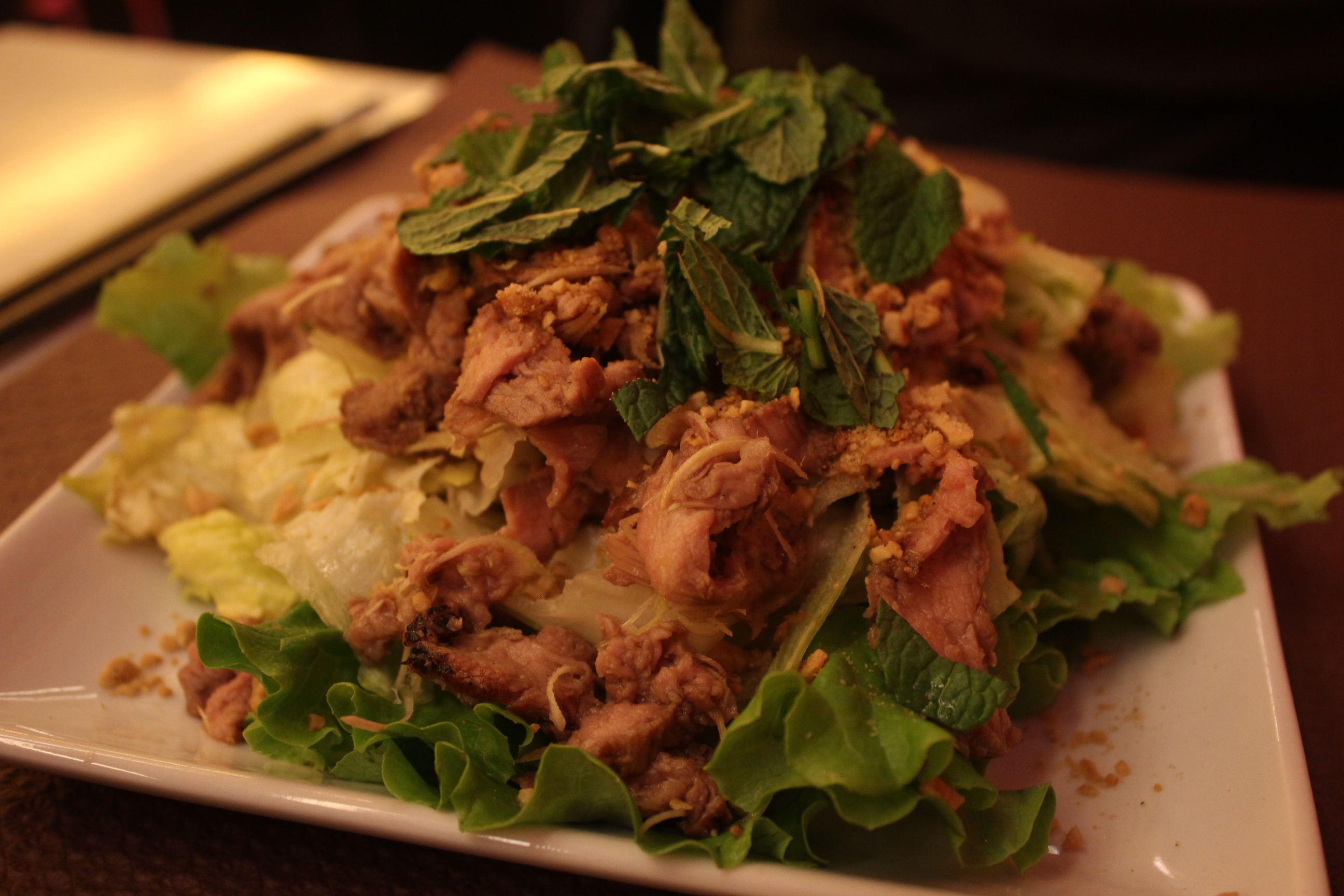 serves the purpose very well as its taste is quite neutral. Our lemongrass beef salad tasted really fresh: something you would want to eat when it is really hot in Paris. Salad was particularly crispy, beef tender and there was a lot of mint. Both starters were copious and very, very good. Nothing was spicy, but Cambodian food is not traditionally very spicy compared to for example Thai food.
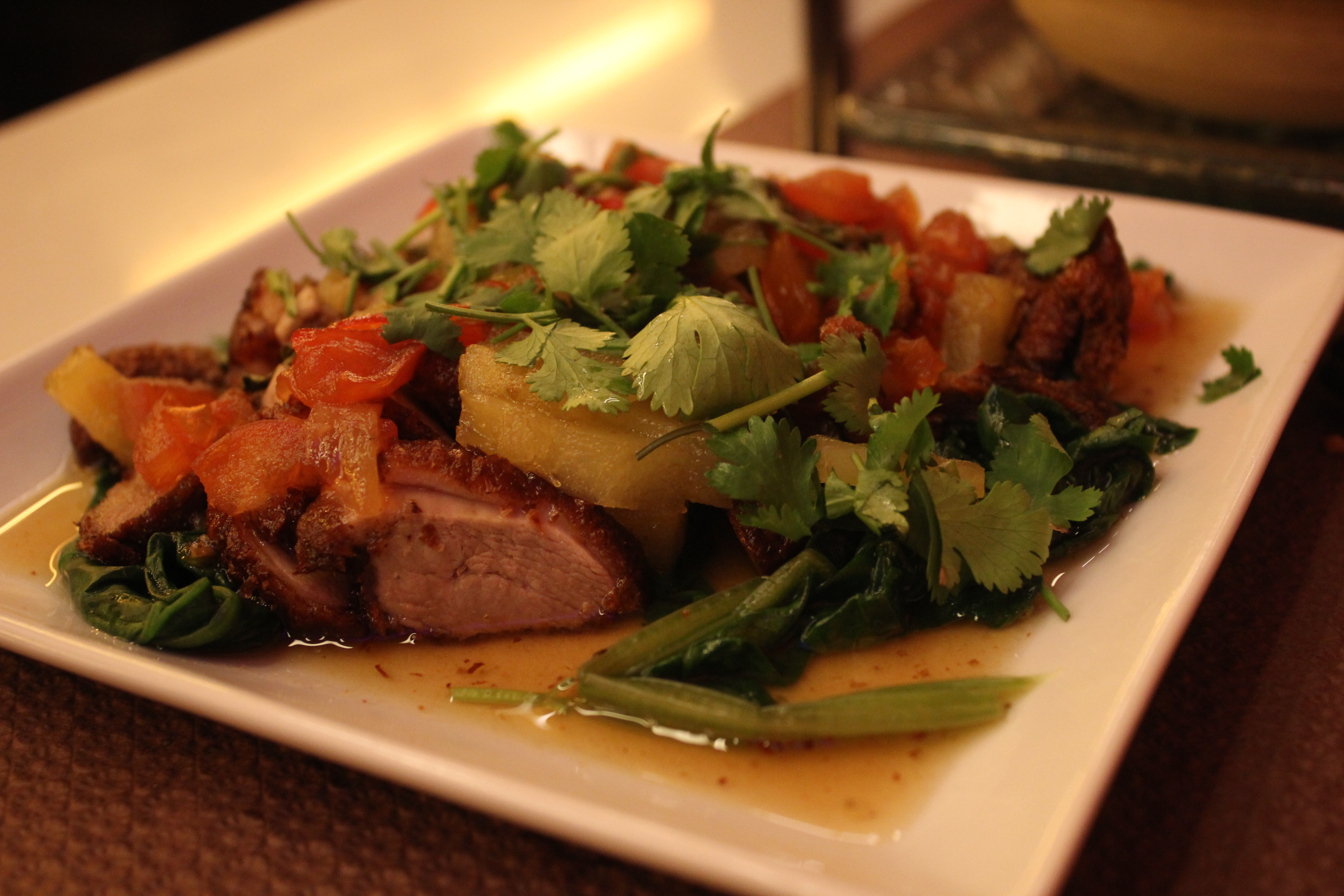
For main course, we ordered Tear bom pong empile thom (duck in tamarind sauce, green vegetables, dried basil leaves and coriander) and Curry sach moan (chicken, potato, carrot, coconut milk curry).
We were particularly interested in tasting the tamarind duck, because it is our favorite dish at an other Asian restaurant (Lao Lane Xang). The Bayon version was slightly different and had pineapple in it. I was surprised of this addition, because in Cambodia I never had pineapple in anything I ate, but Jean-Marc assured me that pineapple is traditionally used in the Khmer cuisine.
Our second main course, the curry, was full of potatoes and carrots, as we had had it in Cambodia. Jean-Marc explained that usually sweet potatoes are used in this type of a curry, but that due to its scarcity in Paris, potatoes make a good replacement (and I could not agree more!). We found this curry delicious but unfortunately could not finish it (portions are quite large and size-wise there is no big difference between starters and main courses).
We indeed had a very lovely Saturday evening. The setting is not particularly romantic (it is more cafe-like), and even the outside appearance may make you wonder where you are walking into, but what you eat inside is authentic and savory. It is always a good sign when tables are filled with locals and I now mean Cambodians! (FYI: there is a new, additional page to the menu, which specializes in dishes even more authentic, like fermented fish etc.)
Bayon Restaurant: 121 rue Monge, 75005 PARIS. Metro: Censier-Daubenton and Les Gobelins. Open daily 12h-15h & 19h-22h30. Closed on Sunday and Monday evening. Tel: 01 43 36 67 43.
If one day there is a competition for The Ultimate French Meat Dish, I know the winner will be the Côte de Bœuf! And many French and international chefs seem to agree. When interviewed and asked about their favorite meat dish, or what meat they serve at a casual friends get-together, they often refer to this beautiful chunk of beef meat that comes with a bone. In English this piece of meat is called “a rib-eye on the bone” (http://www.jamieoliver.com/magazine/blogs.php?title=what-s-your-beef) or “a T-bone steak”, but I will stick to its French name.
We usually prepare the côte de bœuf once a month and serve it with salad and 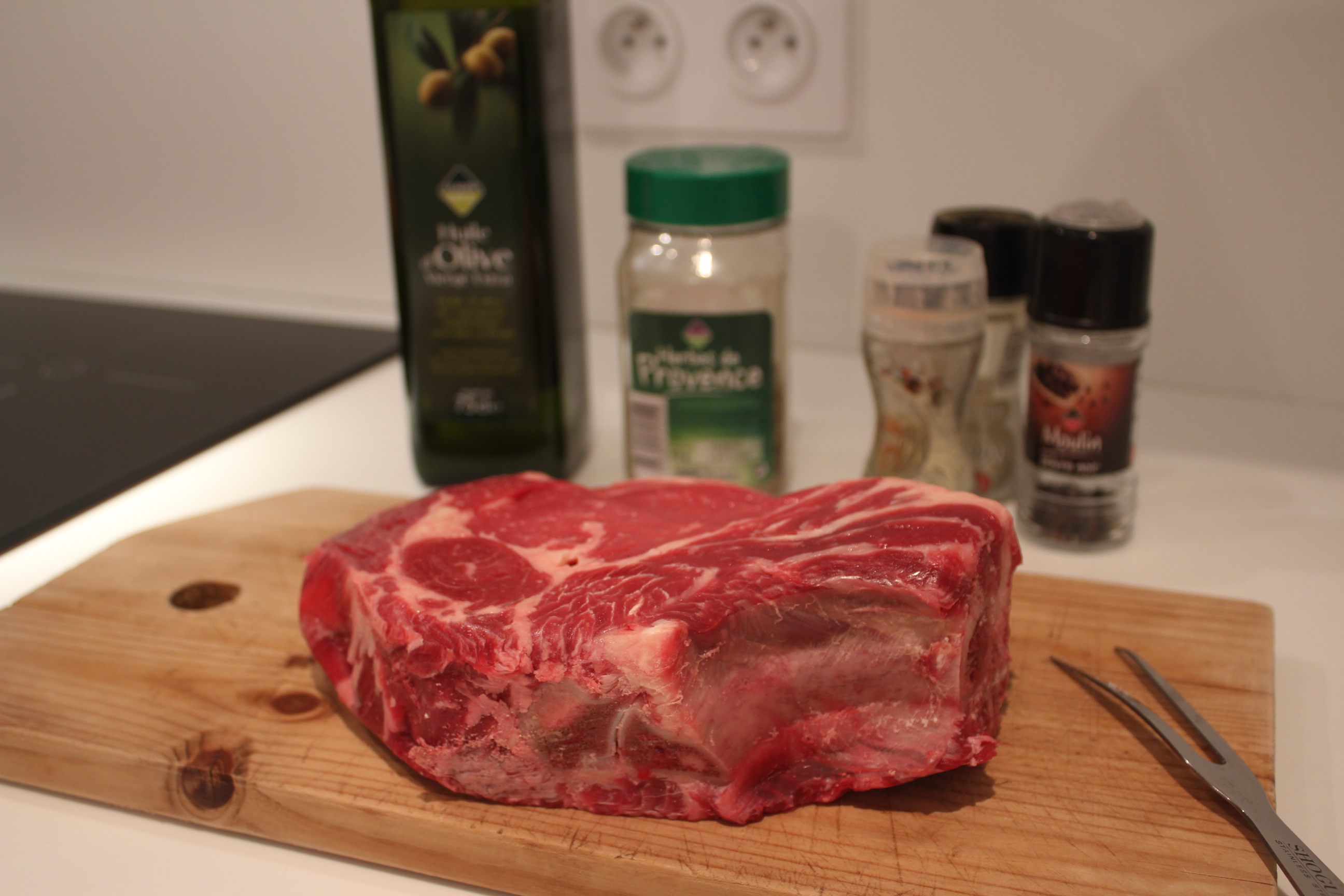 a nice bottle of red. I am very bad at following any recipe (I prefer to invent them myself) and I am equally bad at writing them down (I never do that either) so if you have difficulties following the recipe I am trying to compose here, do not hesitate to email me should you have any questions.
1. Buy a nice-looking piece of meat, not too much of fat, but with a bone, and leave it at room temperature for 2-3 hours. The piece we buy usually weighs around 1kg, sometimes 1,2kg (the bone included). If you serve potatoes as a side dish, the côte de bœuf can serve four people. If you are two and cannot finish it all, think about eating it cold with mustard the next day…
2. Start heating the oven (around 200C-225C). Prepare olive oil, peppers (usually black and white, but I use Iranian green, too, that I recently bought in Dubai) and Herbes de Provence (oregano, thyme, basil, rosemary, satureja and marjoram). We never add salt at this p oint (as you keep reading, you will see why). Cover the côte de bœuf with pepper and herbs, and remember: the more, the merrier! Herbs are good for you!
3. Admire your beautiful côte de bœuf and smell the herbs. Have un apéritif, maybe a glass of rosé from the South of France? Make sure that you have opened the bottle of wine that you will serve for dinner (just don’t drink it yet!).
4. If you have more people coming over to eat, or if your côte de bœuf is particularly small, then you can serve potatoes with it. We find that a salad is enough and makes the dinner less heavy. However, should you want the potatoes, halve them and put them in the oven before the côte de bœuf as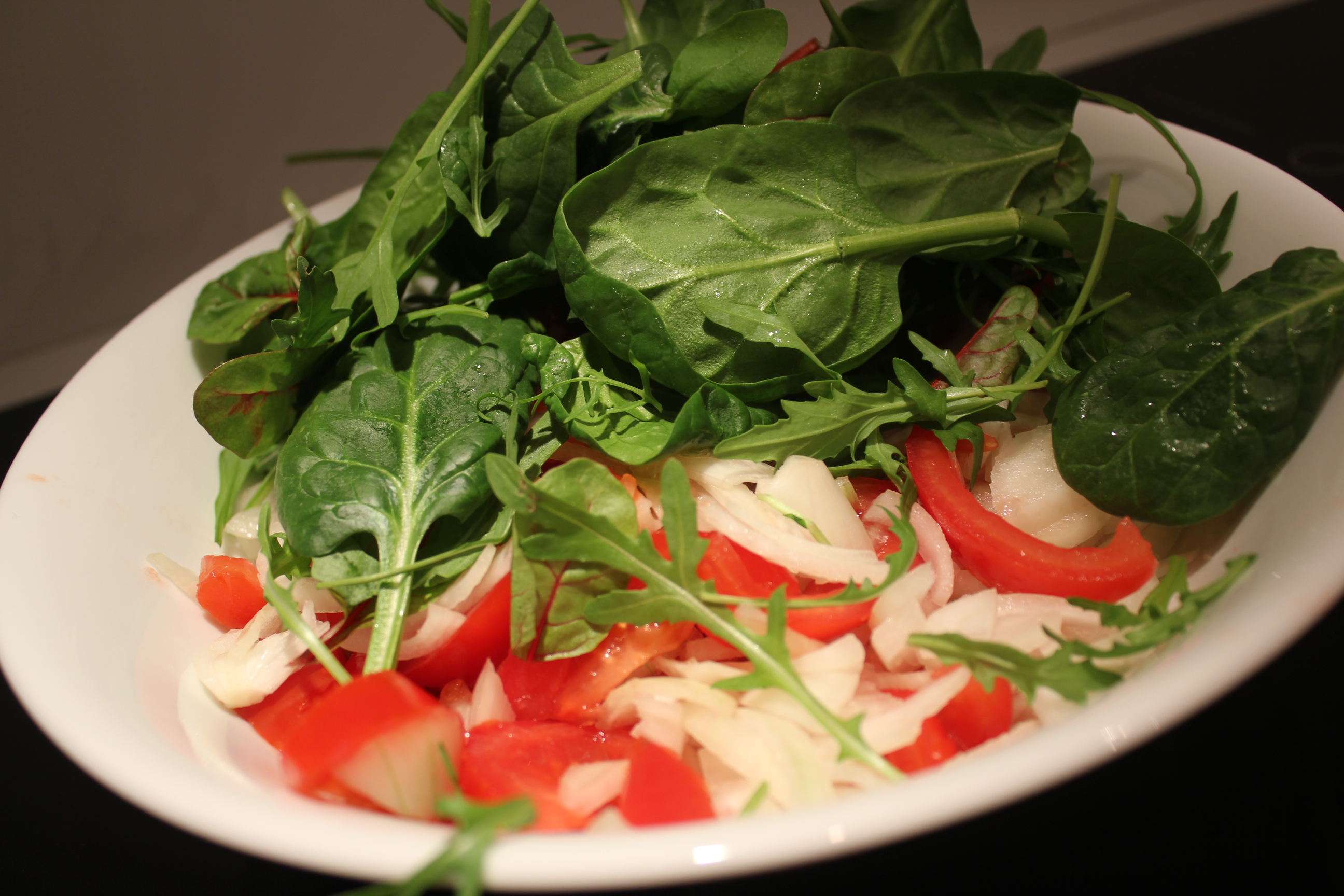 they take longer to be cooked. Place the potatoes in an oven bowl in the lower middle part of the oven so that while the côte de bœuf is being grilled, its extra fat runs on the potatoes.
If you skip the potatoes part, then start preparing the salad. We like it very simple: roquette, beetroot and spinach leaves, mixed with slices of tomatoes and onions.
5. Every cooking experience has un moment stratégique. Putting the côte de bœuf in the oven is one of those moments, because from now on you have to start watching your clock. Depending on the size and thickness of the chunk of meat, your oven, your taste, etc., the côte de bœuf should be in the oven for approximately 20 minutes, maximum 30 minutes. 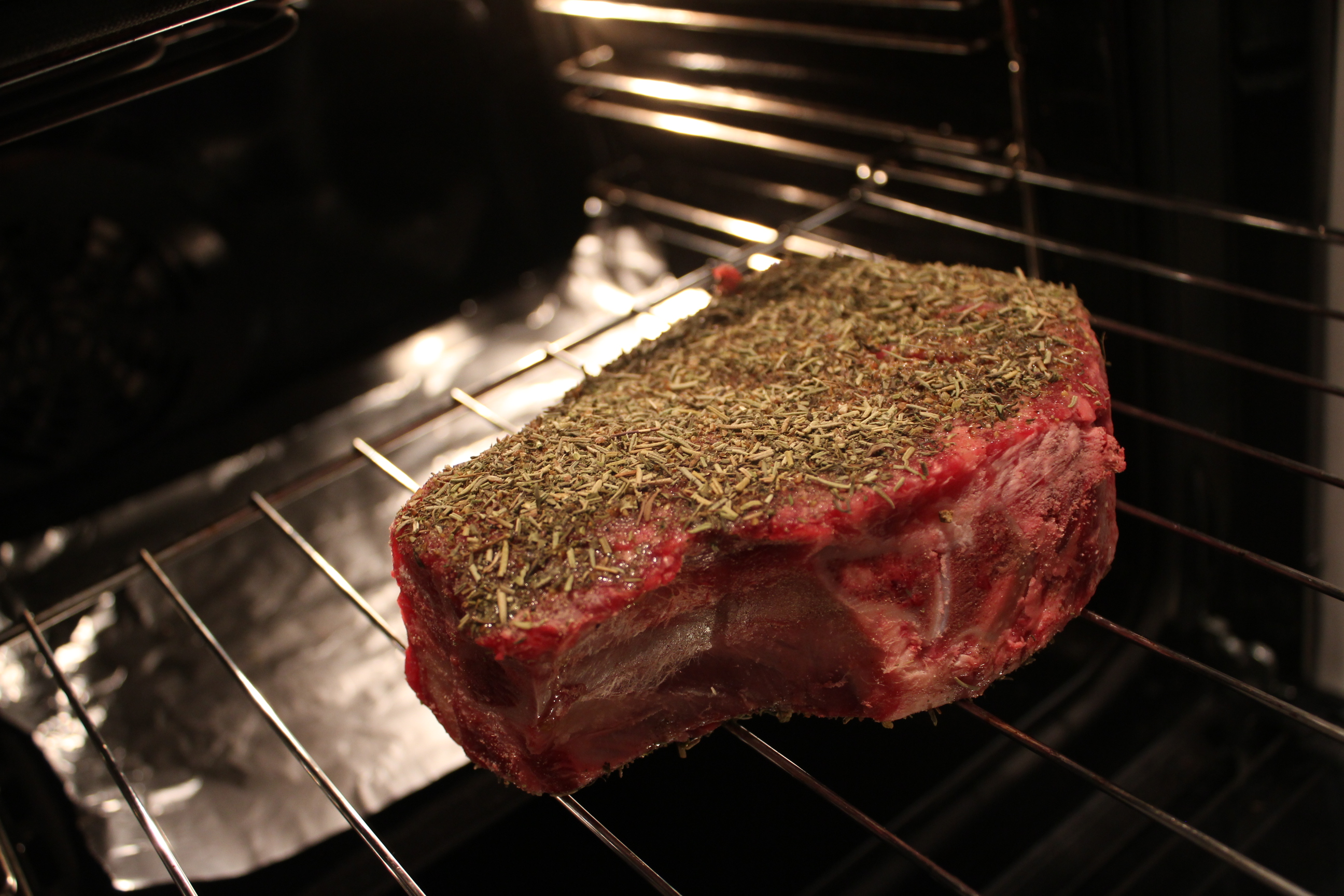
Place the oven rack on the upper middle part of the oven, and put the côte de bœuf directly on the rack (the aluminium foil that you see in the photo is only to cover the bottom part of the oven from the fat!). Cook it for 10-15 minutes on each side. Depending on the greasiness of the meat and the general quality, you may have a lot of smoke coming out when you open the oven, so keep the kitchen windows and ventilation on!
6. Get the côte de bœuf our of the oven. For juiciness, it is recommended to wrap the meat in aluminum foil for 15 minutes before serving it, but I rarely do it.. Maybe I do 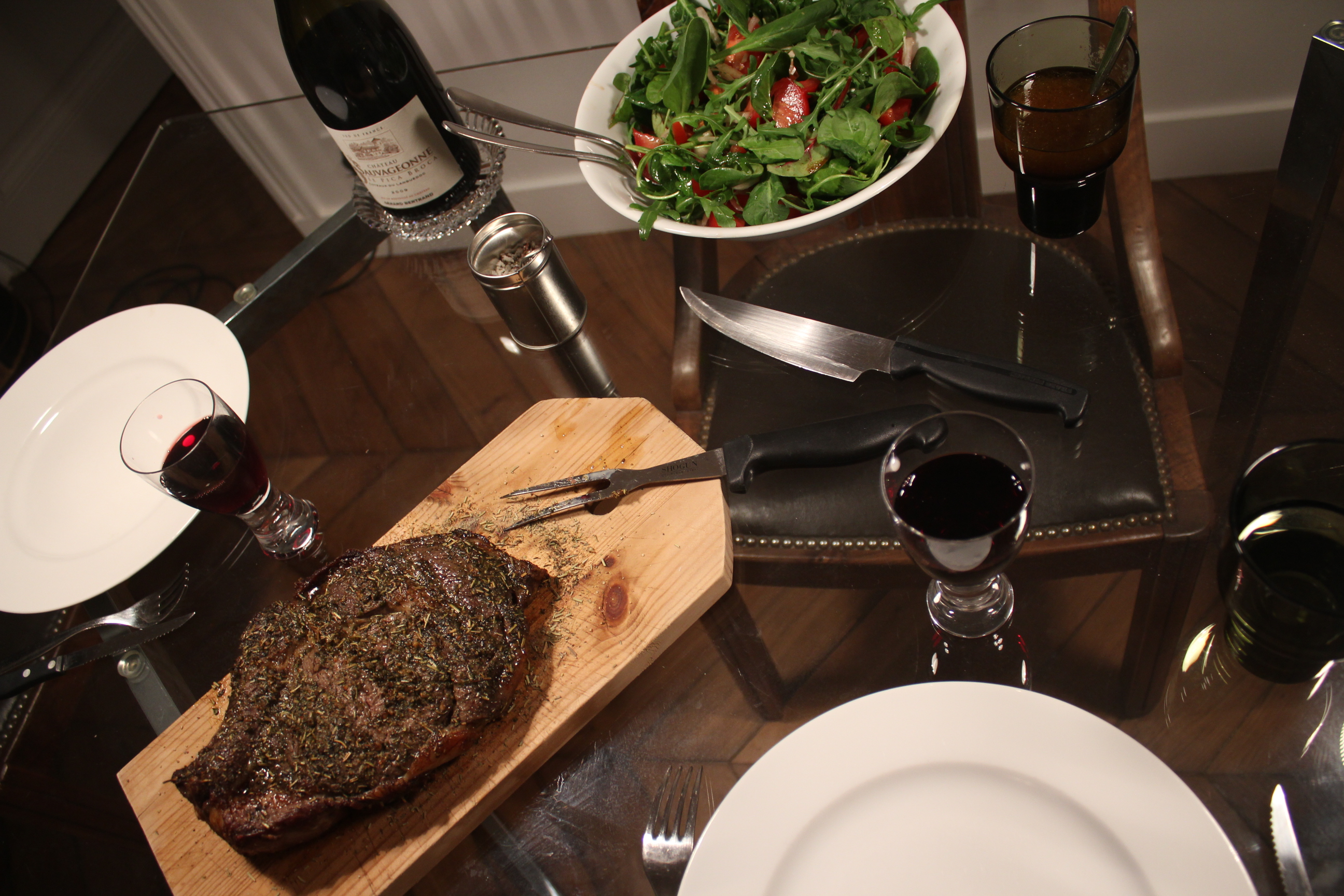 something wrong, but to be honest, I don’t see the difference it is supposed to make, so I don’t do it. So if you like, you can do as we do, and bring your côte de bœuf to the table and cut it into thin slices in front of everyone.
It is only at this point that the salt is added: the type of salt that is sprinkled on the côte de bœuf is coarse sea salt. If you want to make your dinner even more perfect, buy the salt that comes from Guérande, located in the Southern part of Brittany where salt making goes back to the Iron Age (http://www.leguerandais.fr).
7. Serve the salad (and potatoes if you made them), not forgetting the wine. We had purchased a bottle of red from 2009, Château la Sauvageonne, Cuvée Pica Broca, Langu edoc Roussillon, Coteaux-du-Languedoc AOC (http://www.1907.fr/nos-domaines/domaine-la-sauvageonne/domaine-la-sauvageonne-pica-broca-terrasses-du-larzac-rouge.html). This time it was not a bottle of independent winemakers, but one of Gérard Bertrand, a big name in the French and European wine merchant business (http://www.gerard-bertrand.com).
I hope you enjoy this very-easy-to-make meat dish as much as I do, and Bon Appétit!
 Le Baron Rouge is an excellent wine bar located at 1 Rue Théophile Roussel, 75012 Paris (near le marché d’Aligre) open all year around but if you love oysters and live nearyby in Paris, hurry up! Tomorrow is the last day they sell oysters that come from Le Cap Ferret.
Our stay in Siem Reap was far from perfect, but I think I have some tips to share with you should you plan to visit this city in the northwestern part of Camb odia.
odia.
WHEN TO GO: We arrived in Siem Reap on February 11, 2013, which was the second day of the Chinese New Year and therefore probably the busiest week of the entire year. According to Chheuy Chhorn, deputy director of the tourism department in Siem Reap, 41 flights from China and Vietnam landed everyday during February 11-13 (source: http://www.phnompenhpost.com/2013021461364/Business/angkor-wat-sees-tourism-spike-over-lunar-new-year.html). Imagine the abundance o f tourists and then imagine the missing photo opportunities! If you have a choice, do not go to Siem Reap just before, during or right after the Chinese New Year. Siem Reap, thanks to its proximity to Angkor Wat and other famous temples, constantly receives a large number of tourists, but try visiting off season, even during the rainy season.
HOW LONG TO STAY: Prior to visiting Siem Reap many people were astonished at our plan to stay for approximately fi ve days. Many thought two, or at very maximum three days should more than plenty. I still think five days was a good length, and that in general one needs three full days to visit the temples and the surroundings of Siem Reap. Temple tickets are available for one, three or seven days and we purchased a three-day ticket and have no regrets. Since there is so much history, knowledge and beauty to be absorbed, I would recommend splitting those three days over four or even five days (ticket allows you to do so). It took the rulers centuries to build all those temples, so to get a real feeling one or two days is just not enough!
WHERE TO SLEEP: Our main criteria regarding accommodation was to stay at a local, traditional place and support the local economy. So I did some Tripadvisor research before leaving Paris and found a guesthouse called Tranquility Angkor Villa (the photo below with the bed) and booked it over internet. It started badly: upon our arrival at 10pmfrom the airport there was a problem with overbooking (they constantly double book). We searched everywhere on internet to find another hotel to sleep in but everything was full. Everything. The manager suggested we sleep on the mattress on their balcony but after seeing a huge rat run by we said no. To cut the story short, we ended up sleeping two nights at Tranquility Angkor Villa but on the second morning I woke up with hundreds of bites all over my body…… I had been bitten by bed bugs! We had planned to move to another more central guesthouse anyway so off we went. We paid 30usd per night (and got reimbursed half because of the bed bugs) but in my opinion there are so many nicer (and cheaper!) places to stay at for much better quality and location! Do not let Tripadvisor reviews about the owners’ friendliness to fool you. Lastly, two brothers are not even owners…
(As soon as I realized what had happened I wrote a review on Tripadvisor, and I rewrote it upon our return to Paris, and still today, nothing has been published! I see other negative reviews have been written about Tranquility Angkor Villa since our stay but I am still curiously waiting to see when mine comes out, or if it ever will, and why not……)
It has rarely happened to me anywhere in the world that everything is full, but during that week it seemed to be the case in Siem Reap. Almost. For the rest of our stay we slept at Popular Guest House (the photo on the right) which was more centrally located and clean. If you are stuck in Siem Reap and “everything is full”, you may find a room at Popular Guest House because they have over 50 rooms (they are more like a one- star hotel). We found that staff was pretty unfriendly and only interested in money but what can you expect from a place where you pay 10USD per night? There is also a rooftop restaurant but it serves nothing to write home about… (http://www.popularguesthouse.com/)
This said, I would suggest a few places that I heard good things about. Babel Guesthouse (http://www.babelsiemreap.hostel.com/) is a guesthouse located in Wat Bo Road, about 2km from Pub Street (where Tranquility Angkor Villa is also), and it is also recommended by Cambodia and Laos by Eyewitness guidebook. A Finnish couple we met on the Siem Reap – Viantine flight spoke very highly about Babel Guesthouse, saying it was excellent, very clean and food so delicious they didn’t need to leave the guesthouse in the evening. My Home Tropical Garden Villa (http://www.myhomecambodia.com/) is a small, stylish guesthouse with a swimming pool in the same street than Popular Guest House (about 10 minutes walk from Pub Street). This is where we wanted to stay, but could not get a room. Double AC room costs 20USD. A very affordable hotel we heard good things about is Central Boutique Angkor Hotel (http://www.centralboutiqueangkorhotel.com/) where room prices start at 47USD.
In higher category, Hôtel de La Paix is going through renovation and rebranding, and will open as Park Hyatt Siem Reap (http://siemreap.park.hyatt.com/hyatt/hotels-siemreap-park/index.jsp?null) very soon (Q1 2013?). A dear friend stayed at Hôtel de La Paix last year and loved it beyond words. “It was BLISS”, he told me.
Otherwise, most of the four- and five-star resorts are located on the Airport Road: far away from Pub Street but more easily accessible should you want to return to your hotel for lunch in between the temple visits. Just last week a friend stayed at Borei Angkor Resort & Spa http://www.boreiangkor.com/) and he got a very interesting off-season deal “definitely worth the money”.
PS Like us, you may want to have a pool to jump into after walking up and down all those temple stairs under the burning sun. However, unless you spend the money to stay at a fancy resort, you do not need to look for a guesthouse with a pool. First of all, temple visits are time-consuming so you may not even have time for swimming. Secondly, you can use a pool at almost any hotel in exchange of few USD.
WHERE TO EAT: 
During our five-day stay in we mainly ate at Khmer Kitchen (http://www.khmerkitchens.com/) located in the Alley (be aware of other restaurants that carry an almost identical name). We particularly liked fish amok, chicken khmer curry (with pumpkins, potatoes  and carrots) and mango salad. I cannot say the food was very refined but it was consistently good enough, and the setting cosy. Unfortunately the service was quite inattentive and slow most of the time.
One day we tried Angkor Palm (http://www.angkorpalm.com/) because it has a reputation as a good and safe place to get a good introduction to Khme r cuisine . The sampling platter for two (the photo on the right) had nothing amazing on it except maybe the spring rolls…
Our last night in Siem Reap came and it was time to change and try something different, so why not Cambodian BBQ (http://www.restaurant-siemreap.com/html/cambodianbbq.php)? We ordered “Real local BBQ”, 10USD for two, which includes beef, chicken or pork, bell peppers, lettuce, onion, basil, rice and yellow needles. As you see in the photo on the left, the m eat is cooked on the domed part and the vegetables in the stock surrounding the domed part. There was a Khmer sauce for dipping but did it make the barbeque more tasty? Not really. It was a fun-enough experience to do once, but I am sure there are better places to taste authentic Cambodian barbeque.
For coffee, we tried Blue Pumpkin (http://www.tbpumpkin.com/) but were not impressed by their coffee or cookies. However, we really appreciated having a quiet moment early in the morning at Le Grand Cafe. Espr esso was excellent, venue beautiful and service efficient. The woman we met there (manager/owner?) speaks very good French and is very friendly. Le Grand Cafe reminds me of some cafes we visited in Havanna and Santiago de Cuba, and I actually regret we didn’t go back in the evening for a drink.
TRANSPORT & VISITS: Every guesthouse and hotel can organize a guide and a car/tuk tuk, but it is cheaper if you have a direct contact. Toward the end of our stay we got to know a young man called Chhor Chamnan and regret of not meeting him earlier. Chhor has been in tourism business for 13 years, working regularly with the Australian Embassy in Singapore. He is pleasant, reliable and his English is very good –highly recommended. He charges 20USD per day for a car in Angkor area and 40USD to visit the sites more far away. Should you need his guide services, he takes an extra 20USD per day.
His email is chhorchamnan@hotmail.com and mobile number +855 (0) 12786723. (We made a mistake of booking our guide via Popular Guest House and the guide’s knowledge was appalling. Apparently finding a good guide is difficult because the best ones are reserved for tour groups and luxury hotels well in advance)
IN CASE OF URGENCY: In the Northeastern end of Pub Street there is a pharmacy called U-Care (http://ucarepharma.com/) which is really as good and reliable as any Western pharmacy. Staff speaks English and are friendly.
For more urgent needs there is Royal Angkor International Hospital on the Airport Road, affiliated with Bangkok Hospital Medical Center (http://www.royalangkorhospital.com). They may not accept your insurance, so you have to pay upfront (it can get very expensive, as a simple consultation costs around 120USD) and  get reimbursed by your insurance company once back in your home country –not the way it should work!). Right in the center of Siem Reap, near the upcoming Hyatt, there is also Friendship Khmer-China Clinic (no website but easy to find). It is much less fancy, but highly recommended for their availability, reactivity, kindness and attitude (and prices are substantially lower). I probably would not want to spend a night there but some of the most amazing human beings I have ever met work there. As your third option, and should you want something Western, there is Naga Healthcare (http://www.nagahealthcare.com/). In our case Doctor Joost Hoekstra was not very helpful, but he speaks French, too.
BOTTOM LINE: The center of Siem Reap is not very nice. In the evening it becomes a Drinking Factory and the epicenter of all happening is its famous Pub Street (see the photo). We only enjoyed the center in the early morning when everyone else (who was not already visiting temples) was too hang over to get up.  During our Southeast Asia tour we met many people who shared this vision and I think it is a pity. Locals surely are pleased about the foreign currency inflow, but I cannot help myself but to wonder could the tourism have taken a different direction in Siem Reap? This said, I think it is important to separate Siem Reap and the temples. If you are going to Siem Reap, it is most likely because of the temples. So, forget the center and Pub Street, and try to focus on enjoying the beauty of the architecture and understanding the vision of the Hindu kings who built those temples because this is what Angkor really is about and what really matters.
 There are many superb old-fashioned cafes in Paris that I like going to especially with friends visiting Paris. As a bonus, I get to play tourist, too. During these last two days, I have been to Le Petit Marcel near the Pompidou Centre, Cafe de la Mairie near the Eglise Saint-Sulpice and La Palette in the Saint-Germain-des-Prés.
La Palette, like many other similar cafes, was frequented by Picasso and Hemingway, amongst other famous names. When we walked in, the lunch hour was just ending and the waiters were getting ready for their own lunch pause. The snow was falling outside but inside the paintings and their yellow and orange colors warmed us up. Large mirrors on all walls were very scratched. There was a charismatic-looking American couple and us. It was an odd hour for an apéritif, but that is all we felt like having, so deux kir s’il vous plaît Monsieur!
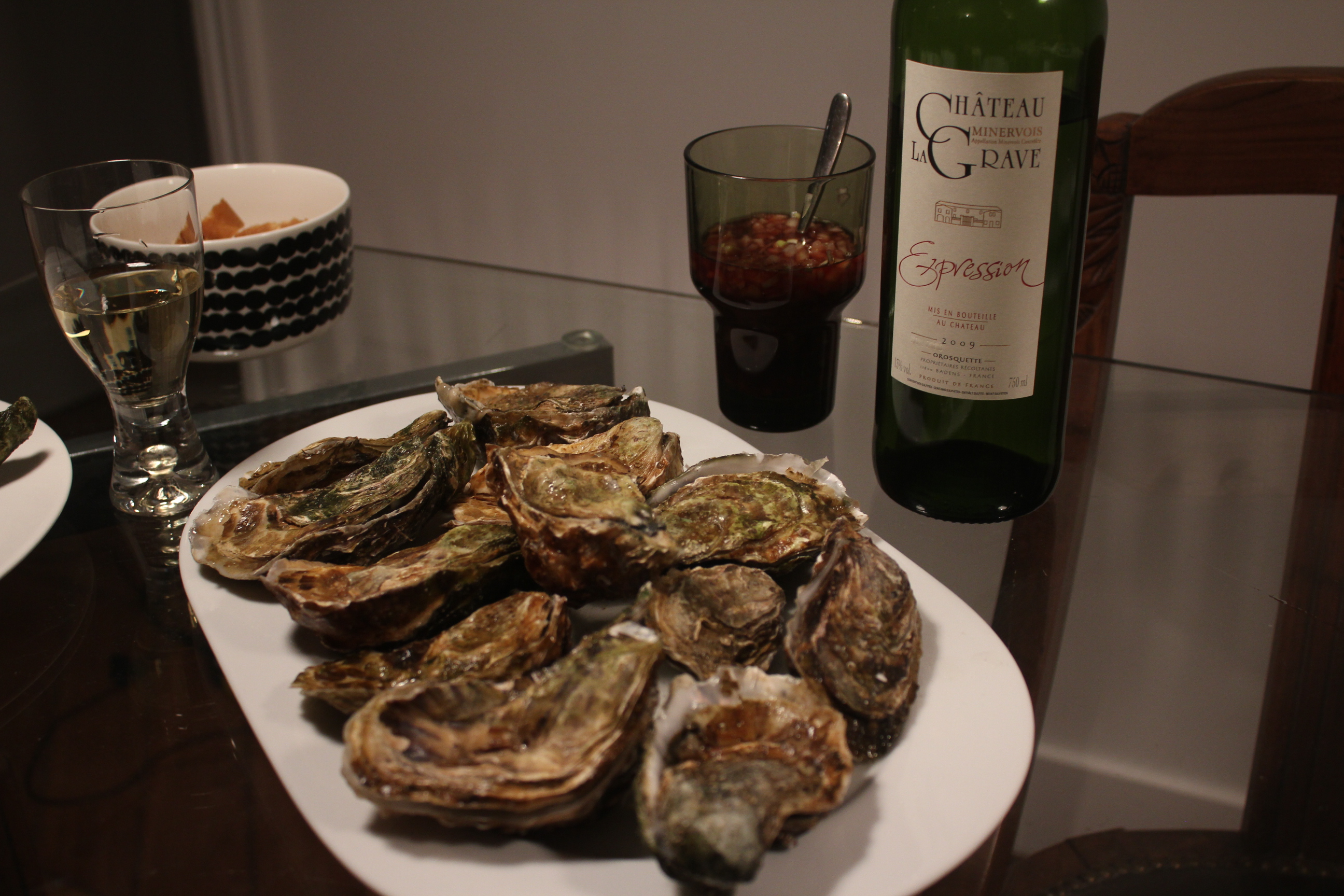
Something that I missed a lot while in Southeast Asia is oysters. Amongst many other benefits, raw oysters are one of the best sources of zinc and I just love the iodine-rich sea water taste. In my opinion, they are best eaten nature, and at most with vinaigre aux échalotes. No t forgetting bread and salted butter, and a bottle of white wine, of course! These oysters come from the Oléron Island, which is France’s second biggest island after Corsica, located off the Atlantic coast roughly speaking between Bretagne and Bordeaux.
To complete the meal, we had chosen three different cheese: Bethmale from the Pyrenees, Manchego from Spain and Ossau Iraty from the Basque country. A perfectly happy marriage between France and Spain and the region in between!
Our local caviste in the 15th arrondissement had suggested an excellent bottle of white wine to go with the oysters: Chateau la Grave ‘Expression’ Minervois 2009 (http://www.chateau-la-grave.net/wines/expression-blanc.html). For the cheese, we had bought Buzet Les Prieurs de Fonclaire 2010 (http://www.nouvelle-epicerie.fr/fr/sud-ouest-provence/5201-buzet-les-pieurs-de-fonclaire-2010-rouge.html). Both bottles cost less than 10€ and far exceeded our expectations.
If you have been following my blog, you know that I rank the national dish of Laos, laap (also called larb) very high on the list of world’s best dishes. To show one more time my admiration for laap, here is one more photo of it. This photo was taken at a restaurant called Boat Bar Restaurant on the main street in Luang Prabang, Laos. Yummy! Should you want to to make it yourself, see my previous post for the recipe (Cooking class in Luang Prabang).
.
My first contact to Laotian food took place in Paris many years ago, at a restaurant called Rouammit in the 13th arrondissement. The same owners nowadays have three restaurants on the same street and since they opened Lao Lane Xang 2, we have been going to this one (http://www.viamichelin.com/web/Restaurant/Paris_13-75013-Lao_Lane_Xang_2-233365-41102). We usually go there at least once a month and in my opinion it is one of the best restaurants in Paris, and I am not only talking about the Asian food category. Needless to say, I was excited to take a cooking class in Luang Prabang to learn more about the culinary culture in Laos. A country that has exported such an excellent restaurant to Paris must have a lot to offer, I figured! 
We chose to have our first Luang Prabang lunch at Tamarind, a restaurant our friend who knows what good food means had recommended to us (http://www.tamarindlaos.com/). The lunch was so tasty that I had no more hesitations about where to do my cooking class, so I booked myself into a one-day cooking class for the next Saturday (classes fill up fast, so book in advance by email!).
Just before 9 o’clock on a Saturday morning everyone met at Tamarind, from where we were taken to a market to learn about the local ingredients. From the market we moved to a beautiful, green setting a bit outside the town, where the culinary secrets were about to be revealed to us.
We started preparing Jeow Mak Keua (eggplant dip). The fact that the ingredients (egg plant, onion, garlic and chillies) were grilled on an open fire gave the dip a smoky taste, and the peeling easier. (The moist should come out while the eggplant is being grilled, so don’t forget to puncture it beforehand!) After peeling these grilled ingredients I pounded them together with coriander, salt and fish sauce in a mortar (a stone bowl). When the paste became soft, our breakfast was ready: apparently Laotians like to eat sticky rice with this dip! So, the next time you fancy a break from your daily croissant or cereal, you know what to do… and you may even not need coffee to wake you up afterward!
The next dish we prepared is called Mok Pa (fish steamed in banana leave). In Cambodia it is called amok, and I have seen t his dish (with different name variations) in almost all Southeast Asian restaurants I have been to.
In a mortar I pounded 1 teaspoon of sticky rice powder, 3 shallots, 1 spring onion, 1 kaffir leave, 2 chillies, 5 thin slices of lemongrass, a bunch of dill and basil, plus a pinch of salt. A generous amount of fish sauce helped the pounding. The next step was to place banana leaves on a fire for few seconds (it makes them softer and more flexible to work with). I then cut the fish into rather large chunks and mixed them with the paste. Lastly, I placed the fish chunks on the banana leaves and folded and tied the leaves (use toothpick to close your banana leaf packages). These packages were then steamed. The next time my father says he has caught too much fish and doesn’t know what to do with the quantity, I tell him to surprise my mother with Mok Pa.
One of the highlights of our lunch at Tamarind a few days earlier had been Oua Si Khai (stuffed lemongrass) so I was pleased to hear it was part of our cooking class program. A s with the previous dish, we started with the mortar and pestle: pound 2 cloves of chopped garlic, 4-5 chopped spring onions, coriander to your taste, 2 kaffir leaves and salt (apparently the blender won’t release the flavors as well as the mortar and pestle). I chose to stuff my lemongrass with chicken and added the minced chicken meat to the paste, but only the imagination is your limit (try fish, shrimps, beef, tofu, vegetables, etc).
Before I could stuff the lemongrass with the chicken paste, I had the most difficult task to accomplish: cut the lemongrass! Actually I will copy paste the instructions from Tamarind, Restaurant & Cooking School, Exploring Lao Cuisine leaflet we were given in the end of our class, as t he cutting technique is quite challenging. “Using a sharp knife, and starting about 1cm from the base of the lemongrass, make a cut right through the stalk for about 4-5 cm, ensuring that both ends of the stalk remain intact, as these ends hold the filling in place. Rotate the lemongrass stalk a quarter turn and repeat. This will give a central hole or cage to hold the filling.”
I managed the cutting part quite ok and after one missed attempt, the chicken paste entered the lemongrass rather neatly. Before I could fry my oua si khai, I dipped them in beaten egg. I asked the chef why we cannot add the egg directly to the chicken paste, but he said the stuffing part will become very slippery (maybe I will try it anyhow one day).
I would definitely like to prepare stuffed lemongrass in Paris, too, but my only concern is where to find such large lemongrass?
While our stuffed lemongrasses were left to cook in the frying oil, we moved onto the last dish: laap. I cannot over emphasize my love for laap (sometimes also written larb) –it is one of my favorite dishes in the entire world. This minced meat (or fish) salad, a national dish of Laos, has several variations, but one of the most common variation comes with beef. We followed the tradition and started putting ingredients together in a bowl.


First we put together everything that you can see on the left-side board (minced beef meat, sticky rice powder, chilli powder, salt and fish sauce) and cooked it on a frying pan during few minutes. Secondly and separately, we finely chopped and mixed garlic, shallot, lemongrass, galangal (Lao tian ginger), chillies, (Chinese) long bean, mint, saw tooth, coriander, banana flower and spring onion (the right-hand board). In the end I added beansprouts and lime juice. For the adventurous ones, there was beef bile duct juice to make it more Laotian. In the end I only had to mix the ingredients of these two bowls, place the laap on salad leaves, and voila, my very first laap was ready!
It was around 2 o’clock and we had made the eggplant dip and three main dishes. It was time to sit down at the table and enjoy the results of this pleasant day. I liked the crispiness of the chicken-stuffed lemongrass and I  found the laap very good and subtle, and various herbs made it taste very fresh and aromatic. Banana leaf package was intact and I was pleased with my folding skills. It was maybe the least tasty dish, but at the same time it compensated for the tanginess of the laap. And when I felt like something more pungent, I had the eggplant dip.
Overall, the day was excellent. Our chef was professional, explained with patience and took time to show cutting techniques in person when needed. Tamarind also organizes an evening course where you do one dish less and there is no market visit, but otherwise it is a convenient choice for those limited with time.
 pearlspotting