Tag Archives: design & decoration

Visiting Agra and Taj Mahal

We left Delhi at 8 a.m. in the morning and arrived in Agra eight hours later (see Road from Delhi to Agra). The closer we got to Agra, the more our excitement grew. Taj Mahal, here we come! Will it be as stunning as everyone claims? And yes, I confirm, it was very impressive to see this enormous white marble mausoleum in the horizon for the first time. Taj MahalAfter dropping our bags at Hotel Kamal, we rushed to Taj Mahal, but the entrance procedure did not go as smoothly as it could have. Our bag contained illegal objects: guide books (!?), a torch and cellular phones, and had to leave them at the entrance (check recent regulations at your hotel). entering Taj MahalAfter passing the security check, we arrived in the garden. Suddenly, there we were, with thousands of Indians, some tourists and cameras in every hand. Once in a lifetime experience.

As Internet and guidebooks are full of information about this extraordinary 17th century mausoleum, influenced by Hinduism and Islam, I am not going to go into architecture and history (for example, Eyewitness India guidebook excels in architectural and historical descriptions). So, I will stick to sharing some more photos: Taj MahalTaj Mahal at sunsetTaj Mahal gardenSunset in AgraImpressive, right?
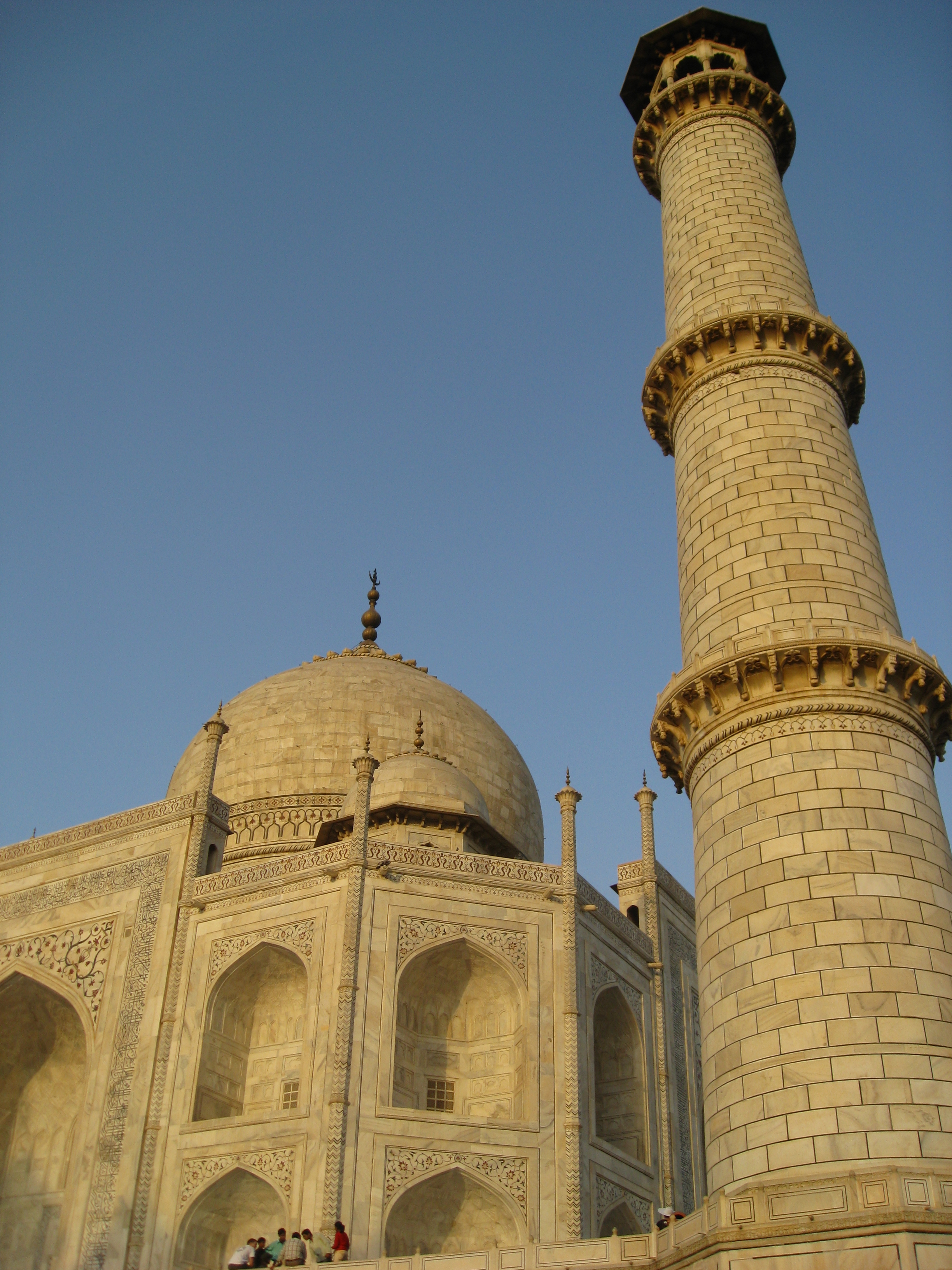
In our opinion, it was definitely worth arriving before 5 p.m. and wandering around Taj Mahal until the sunset. Highly recommended! Moreover, as you know, the sun is so strong in India that even for photo shoots the evenings are much better. Alternatively, you could also arrive very early in the morning.

The next morning we woke up at the sunrise (5.30 a.m.) and climbed to the roof terrace of our hotel. The famous appearance of Taj Mahal was worth the early wake. In fact, I would recommend either staying at a hotel that has a great view, or finding a roof top you can easily access in the morning. Taj Mahal at sunriseAfter the morning photo shoot we walked around the Taj Ganj quarter (in the immediate proximity of Taj Mahal), which left us a pleasant impression. Quiet streets, old gates, rustic but charming houses, and friendly people. walking around AgraWe had breakfast at the roof terrace of Shanti Lodge near our hotel and decided not to visit the Agra Fort and the Agra city center (that surely are worth visiting!). Next we picked up our bags and paid a rickshaw to take us to meet our driver who was waiting for us outside the center. FYI: cars are not allowed too close to Taj Mahal, so your driver may ask you to take a rickshaw to reach your hotel.

It was 8 a.m. and our day was only starting. Fatehpur Sikri, here we come!

TAJ MAHAL TICKET AND ENTRANCE INFORMATION: To my understanding, tickets can be purchased until 5 p.m., allowing you to stay until the sunset. There are also night viewing tickets available around the full moon, but not on Fridays. However, please note this information is based on our travel memories from March 2008 and on Internet reading, so please check the latest information with your hotel prior to arrival in order to avoid disappointments! 

HOTEL KAMAL (http://www.hotelkamal.com/): The hotel was very simple, but we had big windows and hot water. Its location and roof top were big bonuses. However, my quick Tripadvisor browsing shows that recent reviews are not that great. It seems they redid the hotel since our visit and unfortunately there are no prices available on the hotel’s website. So, all I can say is that we were pleased with our stay, but we paid 400 INR ( 4.7€ or 6.5USD). A real bargain!!

EATING IN AGRA: We did not eat particularly well, so cannot recommend anything.

***

PS This is the fourth post about our trip in Delhi, Agra, Rajasthan and Bombay in March-April 2008. Previous posts are:
Part 1. Arrival in Delhi: first impressions
Part 2. Eight cities of Delhi
Part 3. Road from Delhi to Agra

Lastly, have you already joined Pearlspotting?

Road from Delhi to Agra

To travel from Delhi to Agra by car, train or plane, that is the question of many visitors heading to see Taj Mahal!

The distance between Delhi and Agra is just over 230 km, but driving along the old National Highway can easily take 5 hours. When we drove to Agra in 2008 it took us eight hours with some stops… And this is with a driver who knows the road! However, thanks to the recently built Yamuna Expressway the travel time is close to three hours now. Definitely worth the toll.

We met our driver in front of our hotel and begun the journey at the dawn. Navigating out of Delhi was not as painful as I had expected, and we soon found ourselves surrounded by agricultural and industrial countryside, colorfully dressed people and some interesting monuments. road from Delhi to Agra Our first stop on the route was Mathura. This lively, religious small town used to be Buddhist until Hinduism took over in the 8th century. Today, it is known among devoted Hindus as the birthplace of Krishna. Precisely, it is in the temple of Sri Krishna Janmabhoomi were he was born, it is said. No cameras were allowed inside.Sikandra, Akbar's tombFrom Mathura we moved to Sikandra, where the Mughal Emperor Akbar the Great is buried (1555-1605). His mausoleum is a 17th century architectural masterpiece, which Akbar according to a Tartary belief started constructing during his lifetime. It is said to be a forerunner of Taj Mahal and I found it very beautiful. Sikandra, Akbar's mausoleum

I know many travelers catch a plane or a train to Agra, mainly to save time, but now that there is this new road, traveling by car becomes as interesting I reckon. Both Mathura and Sikandra are worth the stop, Mathura for religious reasons, Sikandra for architecture. Both are along the national highway, making it very convenient to visit them if you are on the highway. However, if you are traveling on the Expressway, it probably makes sense to use the fast road until Mathura, and from there until Agra use the highway. But ask your driver…

Whatever you decide, buy some water and enjoy the ride!

PS This is the third post about our trip in Delhi, Agra, Rajasthan and Bombay. Previous posts are: Part 1. Arrival in Delhi: first impressions and Part 2. Eight cities of Delhi

Le Tipaza: refined Moroccan food

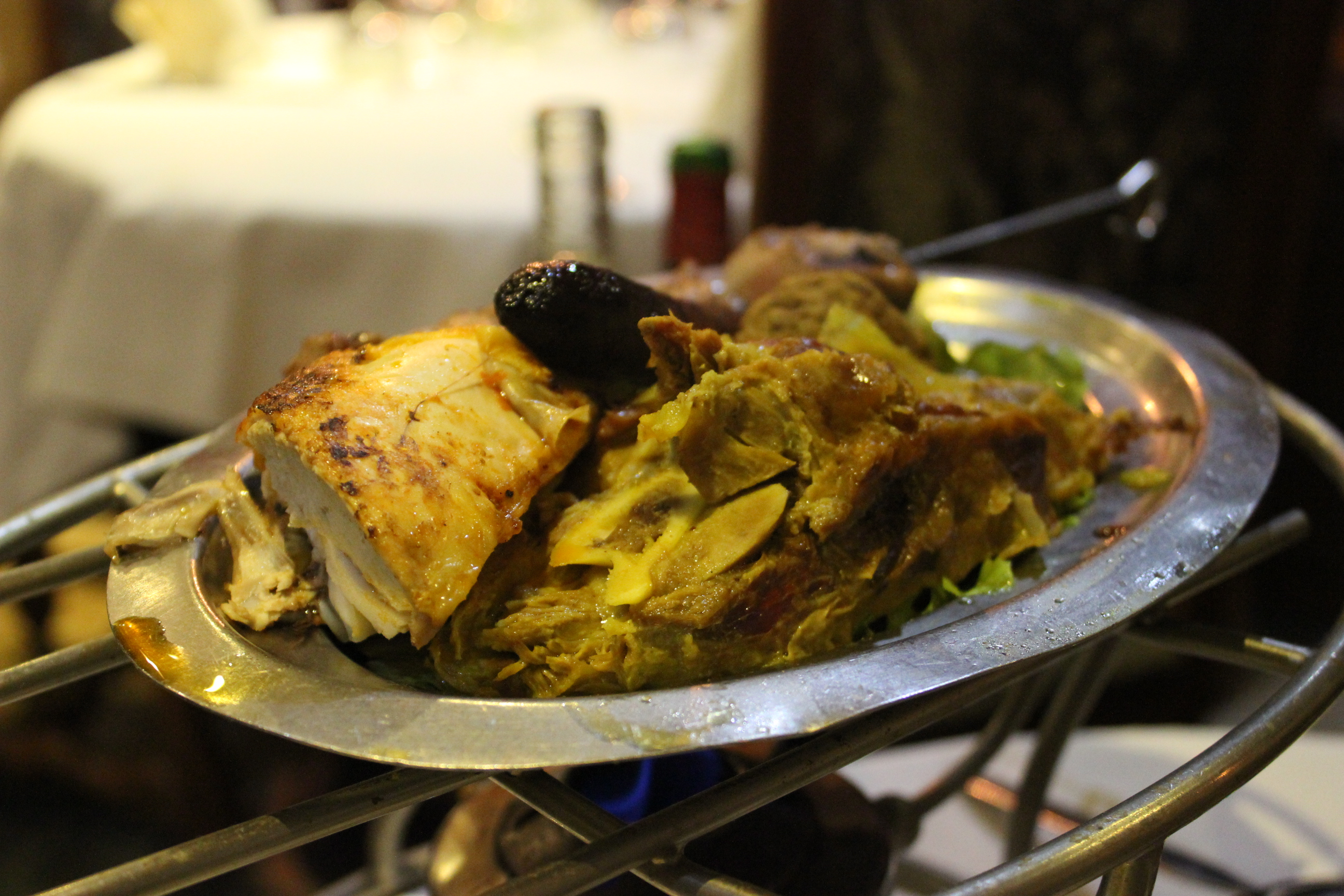
Le Tipaza is located in the northern part of the 15th arrondissement, not far away from the Eiffel Tour and UNESCO. We used to go this Moorish restaurant a lot in the past and were always very pleased with food and service. And yesterday was not an exception! Le TipazaLe Tipaza serves classic North African specialties (couscous and tajine) and some French dishes. My husband always chooses couscous and I take tajine (which is gluten free because it comes without the semolina). The wines come from Algeria, Morocco and France. Le Tipaza, couscousMy husband’s couscous royal came with a large bowl of hearty vegetable stew, a plate of mixed grilled meats, small bowls of raisin and chic peas, and semolina of course. He absolutely loved the stew, beef and chicken. The rest (merquez and lamb) he found tasty, too, but a bit dry. Anyhow, it was an excellent couscous. grilled meat plate, Moroccan foodI usually have tajine with lamb but changed my mind and ordered chicken. The tajine I chose came with preserved lemons, onions and olives. Some potatoes were included in the dish, too. It was delicious!! Such a delight!  tajine with lemons, onions, olivesWe drunk Château Mansourah, Côteaux de Tlemcen (Algeria) and it was a perfect choice: aromatic, slightly maderized red wine made of grapes that grew under that strong African sun. On previous occasions when drinking North African wines we have noticed that they make us really tired –maybe it is the sun effect? Yesterday again we felt the same and in the end of the meal we could have fallen asleep right way. The dinner was very enjoyable and we were happy customers, but indeed the only thing we could have wanted more was a magic carpet to fly us home over Paris!

Lastly, the bill was 51€ for a couscous, a tajine and a bottle of wine. Excellent price-quality ratio!

Le Tipaza: 150 Avenue Emile Zola, 75015 Paris. Tel: 01 45 79 22 25. Metro: Avenue Emile Zola.

***

Previous posts about eating North African food in Paris are:

L’Alcôve: finest meat of Paris (also serves couscous and tajine, but house specialty is grilled meat)
Algerian restaurant l’Atlantide in Paris (excellent couscous and tajine)
L’Homme Bleu: Berber hospitality in the center of Paris (reputable couscous and tajine restaurant but I was disappointed during my last visit)

Tribute to Parisian architecture

As I was returning home this afternoon I stopped to take photos of this building, located right next to our metro station. The station has three exits but this is my favorite sortie. I get out of the tunnel, see the sun light and these elaborate statues salute me, time after time. One of those moments that makes one’s day. Hence this photo, a tribute to the 19th century architects and workers. Bravo.Paris architecture

India: Top 10 places to visit

This is not your usual guide to India, which directs you to Taj Mahal, the Golden Triangle and Goa. I am not saying these places are not worth visiting -they are- but my goal is to show the richness of India by introducing diversified, less obvious places to visit. Namaste! Taj Mahal

My Top Ten of India (in alphabetical order):

1. Badami (Karnataka). Why? The capital of the Chalukya Kings during the 6th-7th centuries. Stunning cave temples dedicated to Hinduism and Jainism. Badami is also a small, pleasant and rather green town.

2. Chettinad (Tamil Nadu). Why? Chettinad is a region and its capital is Karaikudi. It is the home to Nagarathars, people renowned for their financial and banking skills, who migrated to South and Southeast Asia in the 19th and 20th century. With the money they made abroad, many splendid mansions were built in Chettinad, making the region an architectural pearl. Moreover, Chettinad is famous for its distinctive, delicious cuisine.Chettinad

3. Ellora (Maharashtra). Why? A group of rock-cut temples devoted to Hinduism, Buddhism and Jainism. A UNESCO World Heritage site. The most famous temple Kailasanatha, built in the 8th century, was carved from one rock, hence a true architectural masterpiece.

4. Hampi (Karnataka). Why? Another UNESCO World Heritage Site. The capital of the Vijayanagara empire in the 14th-17th century. Impressive Hindu temples scattered around a huge terrain. Do not miss the Elephant stables!

5. Hyderabad (Andhra Pradesh). Why? A crazy, noisy and polluted city. Closest I have been to Pakistan (what I imagine Pakistan to be like). At the same time, Hyderabad is amazing and fascinating!! The world’s Biryani capital. Excellent Biryanis.Hyderabad

6. Kannur (Kerala). Why? Not many people have heard of Kannur, but if you want to see the famous Theyyam performance-ritual, this is the town where you will be based. Theyyam is more than 2000 years old and a definite must see. (Note: I had hard time choosing between Kochi and Kannur, but chose Kannur because Theyyams are less known than Kochi)

7. Mamallapuram (Tamil Nadu). Why? Built in the 7th century by a Pallava King, Mamallapuram is an other fantastic UNESCO World Heritage site. Elements of Dravidianism, Buddhism and Hinduism. Stunning monolithic rock carvings and sculpted reliefs. For elephant lovers. Mamallapuram

8. Shekhawati (Rajasthan). Why? Located on an old trade route, Shekhawati region is another architectural pearl, full of spectacular merchants’ and industrialists’ houses. These houses are real storyboards and their frescoes tell a story of the late 19th century industrialization. Read more: Shekhawati: the Haveli Hub

9. Tirupati (Andhra Pradesh). Why? Tirupati is your base for visiting the Shri Venkateshvara Temple located in the Tirumala Hills. One of the most important Hindu pilgrimage site in India. In the league of Vatican and Mecca in the global context. Talking about the power of religion.

Udaipur10. Udaipur (Rajasthan). Why? The Venice of the East. Probably the most romantic city of India. Sleep in an old palace and you will see why.

What is your favorite place in India and for what reason? And if you haven’t yet been to India, then what would be your top three places to go to?

PS Join Pearlspotting on Facebook!

Playing with still life in Paris

still life, Paris


Mirror: Antique, French. Not quite sure, 18th or 19th century?

Green vase: Designed by Helena Tynell in the 1960’s. Produced by Riihimäen Lasi, Finland (http://www.laatutavara.com/index.php?hakuteksti=aurinkopullo&page=haku)

Candle holder: Designed by Heikki Orvola in 1988. Produced by Iittala, Finland (https://www.iittala.com/Series/Iittala/Kivi/c/Kivi).

Pendant lamp seen in the mirror: Alvar Aalto bell lamps from 1937 find a new home in Paris and Alvar Aalto bell lamp


Easy oven-roasted cauliflower

A friend recently sent me a recipe, which included broccoli, but since I had cauliflower at home, I used that. Since that day I have made the recipe several times and cannot seem to get enough. Some people eat chocolate for a snack, I opt for cauliflower!

So, how to begin? Buy a large cauliflower. Cut it into florets. Place them in a large oven-safe bowl. Sprinkle olive oil, black pepper and salt. Add crushed garlic. Roast in the oven (225C) for 30 minutes (cooking time depends on your taste and on the size of florets, so taste to see how you prefer your cauliflower). oven-roasted cauliflowerOnce the florets have obtained nice color, remove the bowl from the oven. Immediately after, sprinkle with Parmesan cheese (again, add according to your taste). And voila, the dish is ready to be served!! See, super easy and fast to make! oven-roasted cauliflowerFYI: the original recipe said squeeze a lemon at the same time when adding Parmesan cheese, but I have not yet done that. Maybe one day.

PS In case you are wondering, the tiles (carreaux ciment) are from a shop called Mosaic del Sur. Their production takes place in Andalusia, Spain and Morocco. If you are looking for original and beautiful tiles, this is The Place! They have a showroom in Paris, and even if you are not renovating at the moment, stop by to admire these elegant pieces of art! (http://www.carreauxmosaic.com)

***

If you are on Facebook, why not to check Pearlspotting’s Facebook page?

What to drink with foie gras?

To pair food and wine is not always straightforward. Even if my principle is “pair it as you like, what you personally prefer”, there are some foods that are trickier than others and deserve more thinking. Foie gras is one of them.

We served foie gras yesterday with toasted pain d’épices (sweet, spicy bread) and coarse salt (sea salt). I had prepared a tomato-onion salad to go with.foie gras and wine

We enjoyed the foie gras with Loupiac (AOC), Château Martillac 2012, and considered it was a successful match (7.80€ the bottle).Loupiac 2012

However, one does have many choices apart from Loupiac, and below you have a list of my favorite foie gras & wine pairing options. I have tried to mention wines that are fairly easily available, too.

1. Champagne: the emperor of the drinks, goes with everything, anytime! If you don’t like sweet wines (the rest are sweet and white), then opt for champagne.

2. Sweet Jurançon: Located in the southwestern part of France, near the Pyrenees, this AOC is probably my favorite among sweet wines. In addition, it has an interesting history: “Jurançon wine occupies an auspicious place in French history. As the story goes, when the future King Henry IV was christened in 1553, his infant lips were touched with a drop of Jurançon wine, which was said to give him lifelong vigor. This practice is repeated to this day at many local christenings.” (http://www.winesofsouthwestfrance.com)

3. Sweet Côtes de Gascogne (IGP): Located in the same region as Jurançon, but a little bit more north, this is another excellent, slightly less-known wine-producing zone.

4. Sweet Monbazillac (AOC): 100 km east from Bordeaux, this is another excellent sweet wine.

5. Sweet Sauternes (AOC): very near Bordeaux, this is probably the most common sweet wine to go with foie gras.

The list is obviously not exhaustive and of course there are many other great wines like for example Le Rêve de Pennautier, “Vendanges d’Après” Vin de France by Maison Lorgeril from Languedoc-Roussillon that I enjoyed over Christmas. This said, what you serve with your foie gras?

PS A tip for the non-French: if you want sweet wine, look for the word vin moelleux in the bottle.

Catching the winter sunlight

Beautiful February sunlight in Paris! winter sunlight


Jewellery: Chaumet and Edouard Nahum, Paris

Wooden box: Traditional lacquer miniature painting, handpicked in Samarkand, Uzbekistan

Silver box: Lancel, Paris


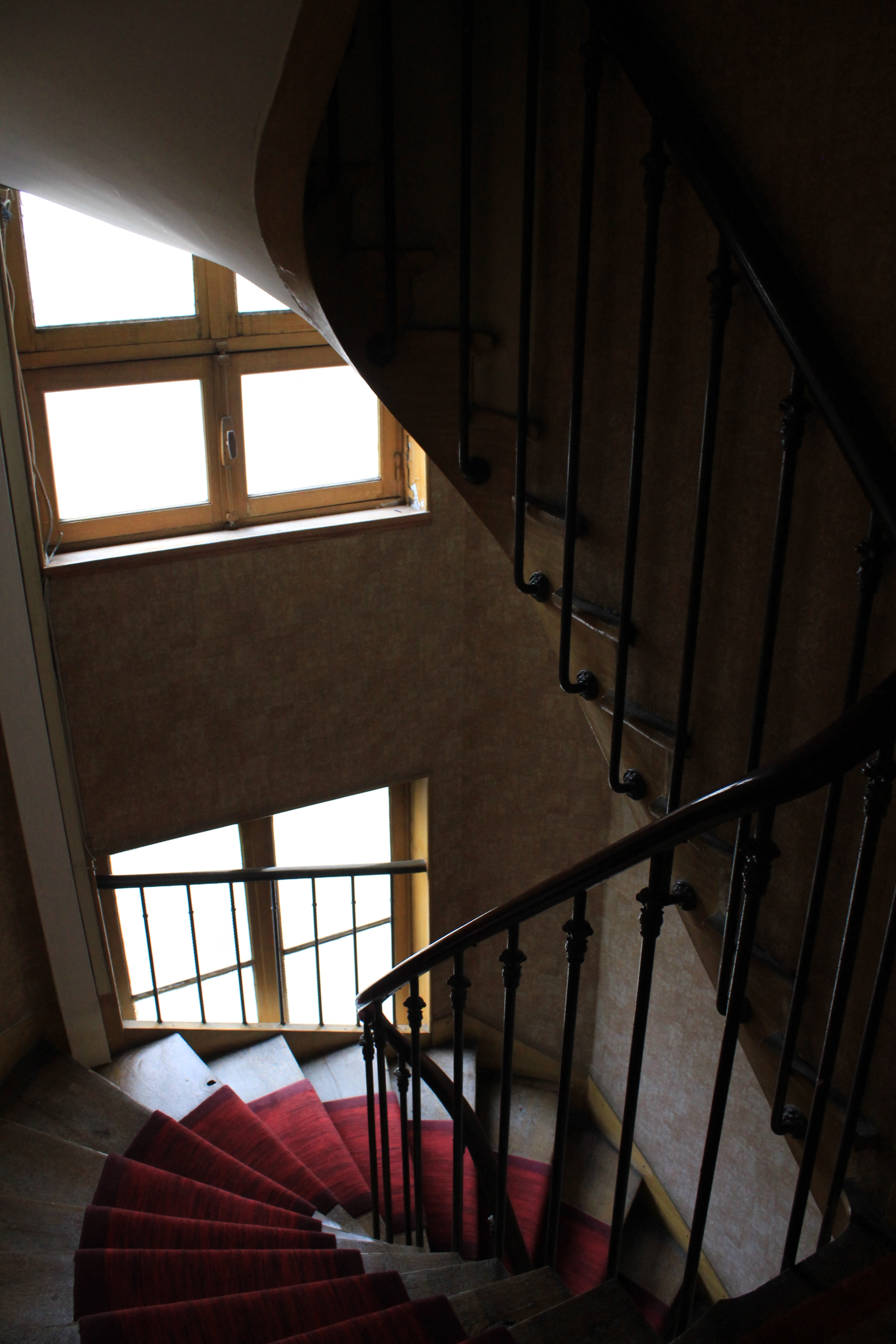
Parisian stairway from 1870’s (before the renovation)

Going through a major renovation is fascinating: words “before” and “after” suddenly get a very deep meaning!

Today our stairway is receiving its first varnish and I thought it would be interesting to show a photo of what it looked like before. I do have many before and after photos from inside the apartment, but unfortunately only one showing the stairway. Better than nothing, I hope! Parisian stairway

I am not quite sure when the stairway was last renovated, but the cork-type of wallpaper hints to the 60’s or 70’s… any architects out there who can help me out?

The carpet, on the other hand, is quite a typical carpet one finds in Parisian building,s but again, I have no idea which decade it comes from.

Ps In case you missed my last post, check it out here: Parisian stairway from 1870′s (a photo I took on Monday this week, showing the new painting). Quite a transformation!!